A Matter of Height: The Impact of a Robotic Object on Human Compliance
Interactions with robots often begin before the first word or gesture. Height, one of the simplest physical attributes, carries strong social meaning among humans. Does that meaning extend to non-humanoid robots?
Research Question
Testing whether the human height-compliance link holds for non-humanoid robots
In human-human interactions, height consistently shapes social dynamics: taller individuals tend to be perceived as more persuasive and authoritative, and people comply more readily with their requests. Studies in human-robot interaction have shown that robot height can have a similar influence on how robots are perceived. At the same time, other findings suggest that people feel more comfortable around shorter robots and often prefer them. What had not been tested was whether height would influence compliance specifically: whether a taller robot would elicit more cooperation, as a taller person typically does.
We are heading toward multi-robot environments populated by non-humanoid machines. How basic physical features like height shape people's responses to them is a practical design question.
The hypothesis followed human-human research: the taller robot would gain more compliance from participants, replicating the height-dominance pattern in an HRI context.
MORPHY: The Modular Robot
A purpose-built platform to isolate height as the only variable
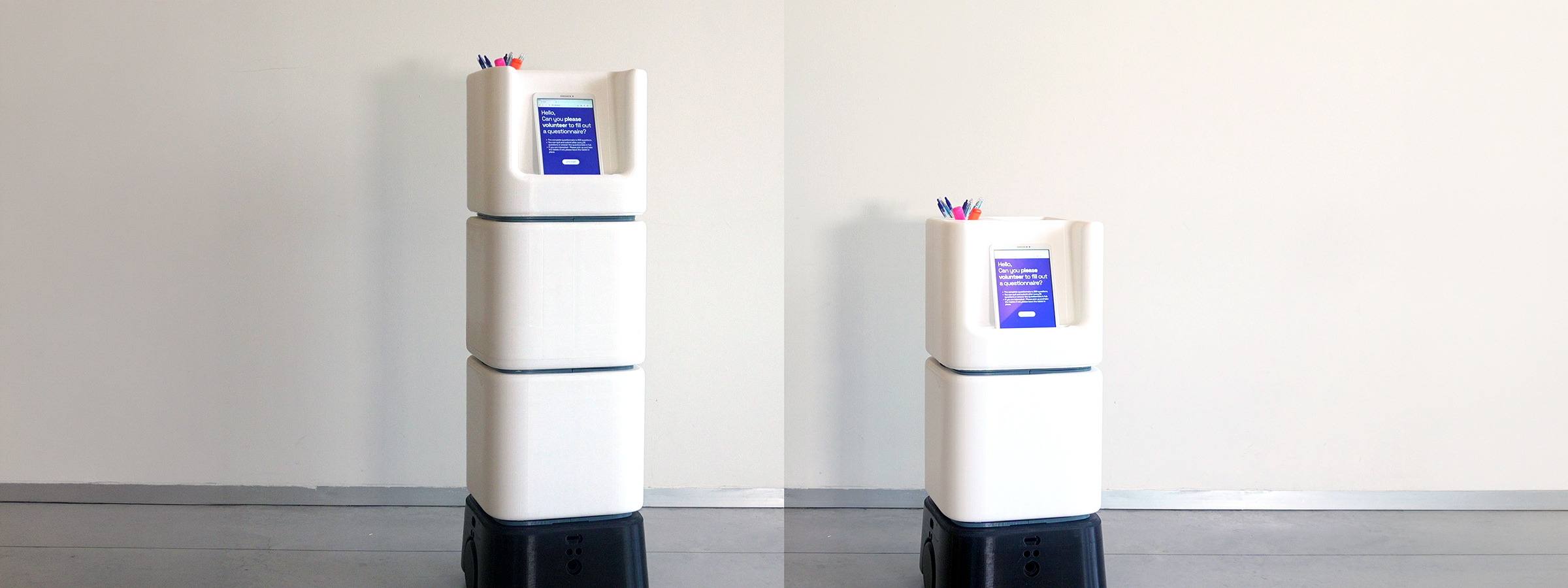
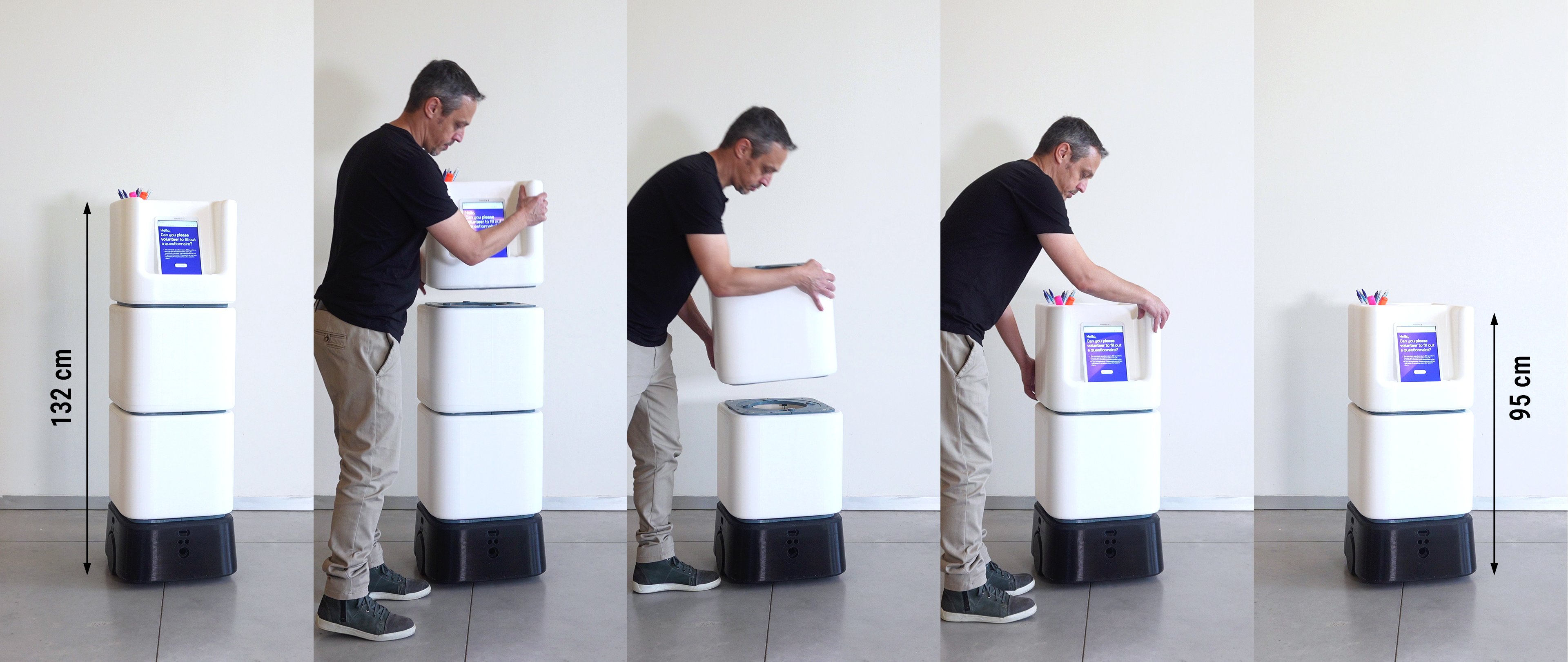
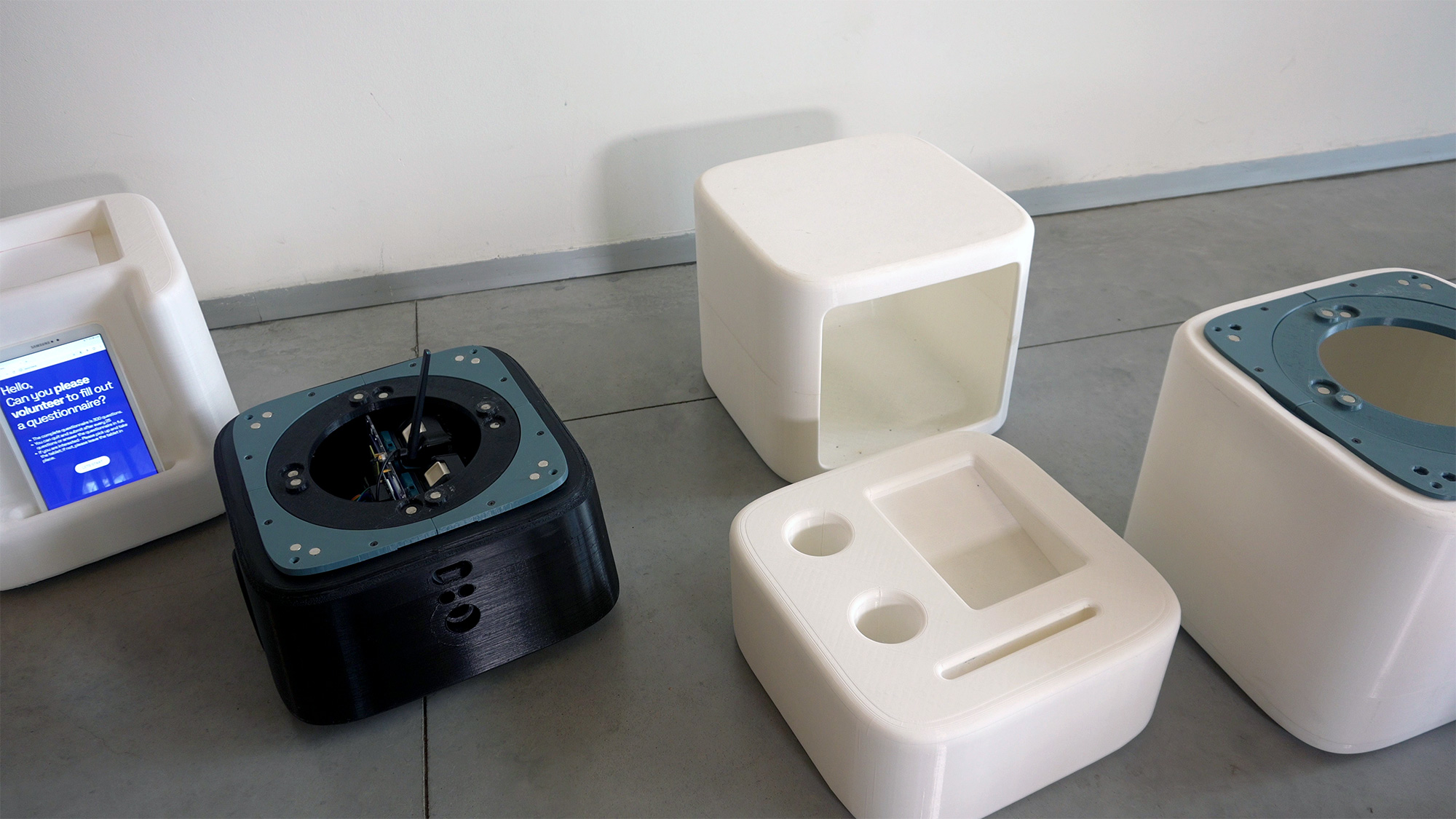
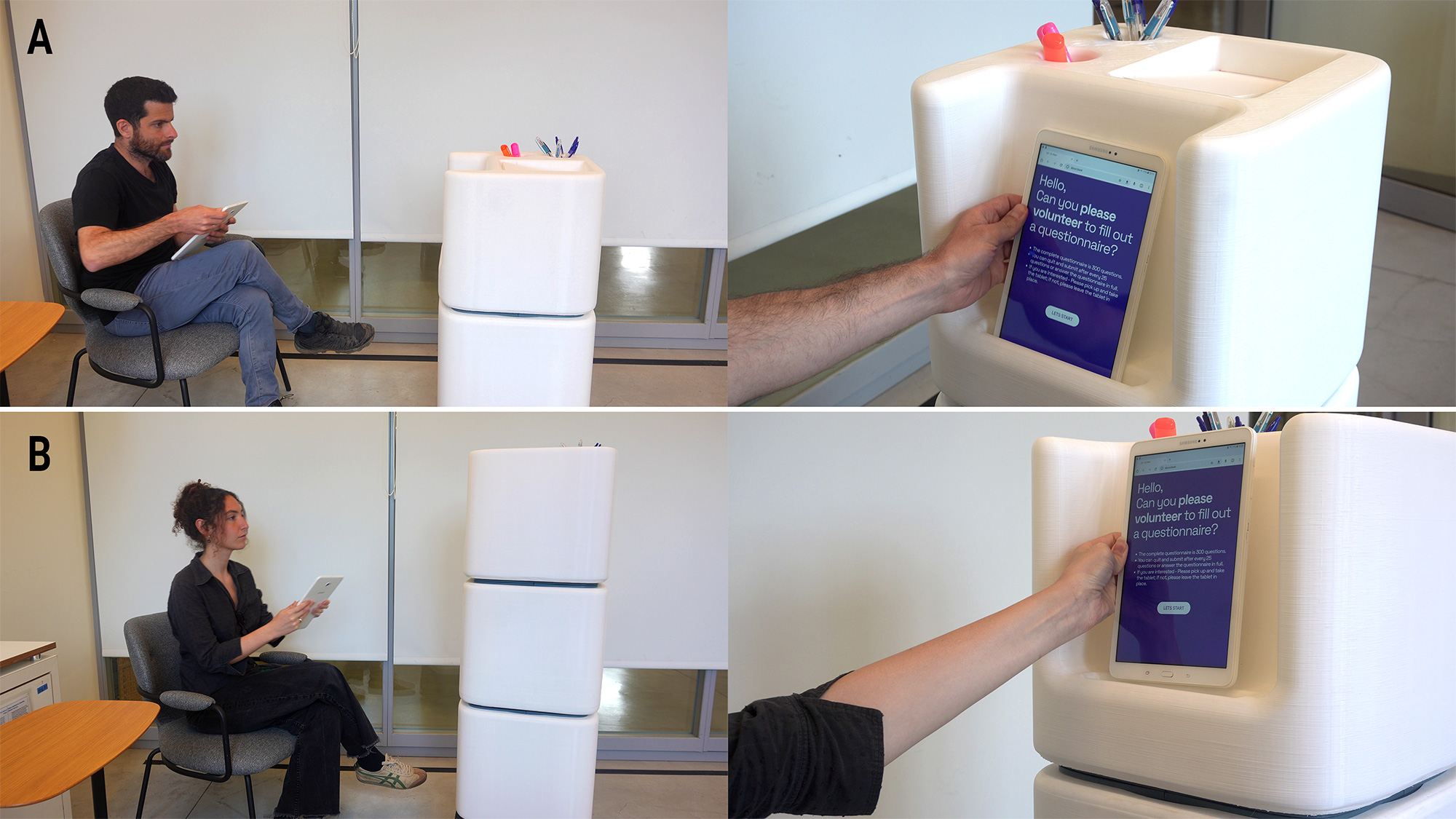
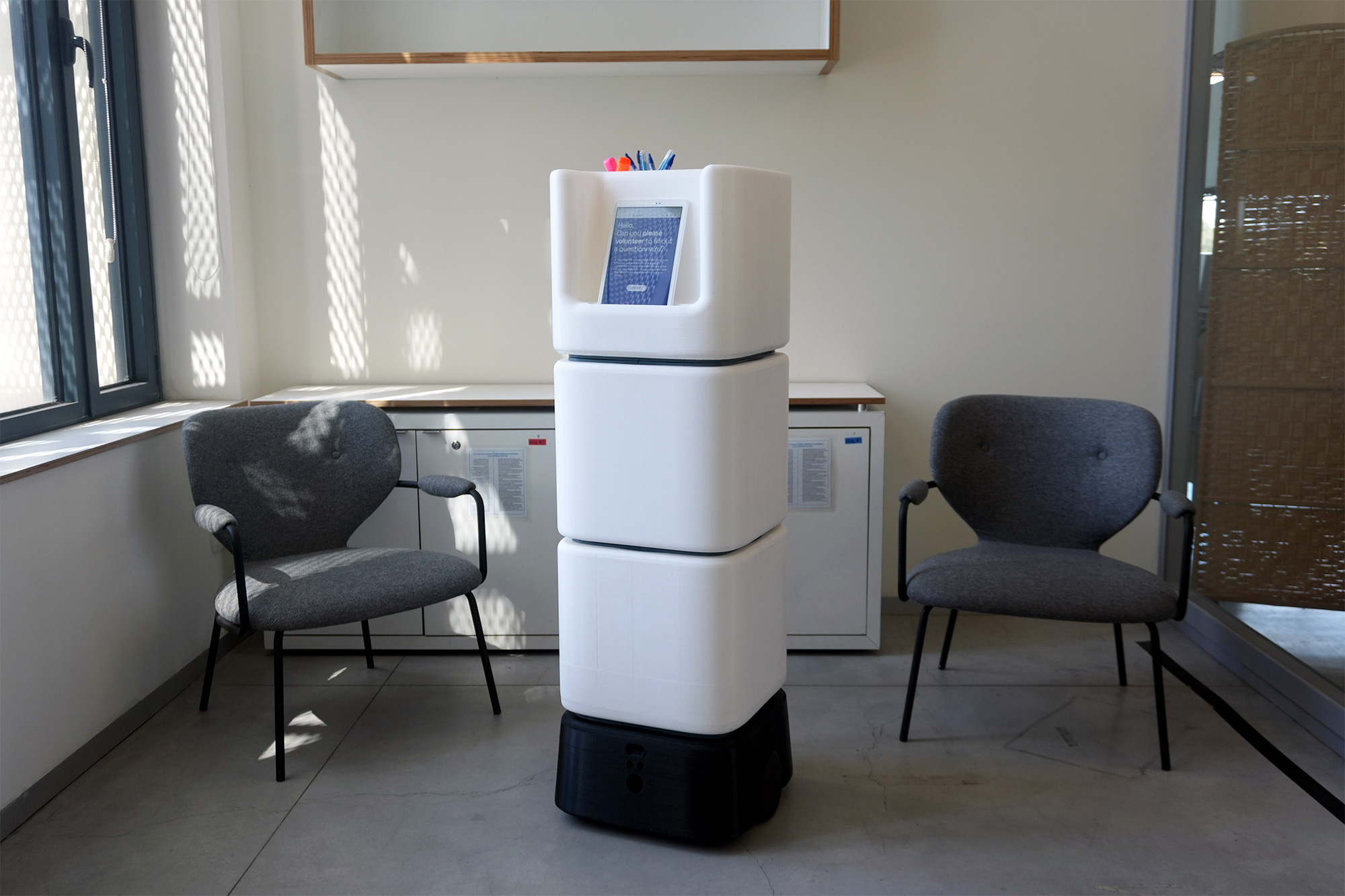
To isolate height as the only variable, I designed and built MORPHY: a modular, LEGO-like robotic service table with magnetized stackable modules. Adding or removing one unit changed the robot's height without touching any other design or behavioural feature.
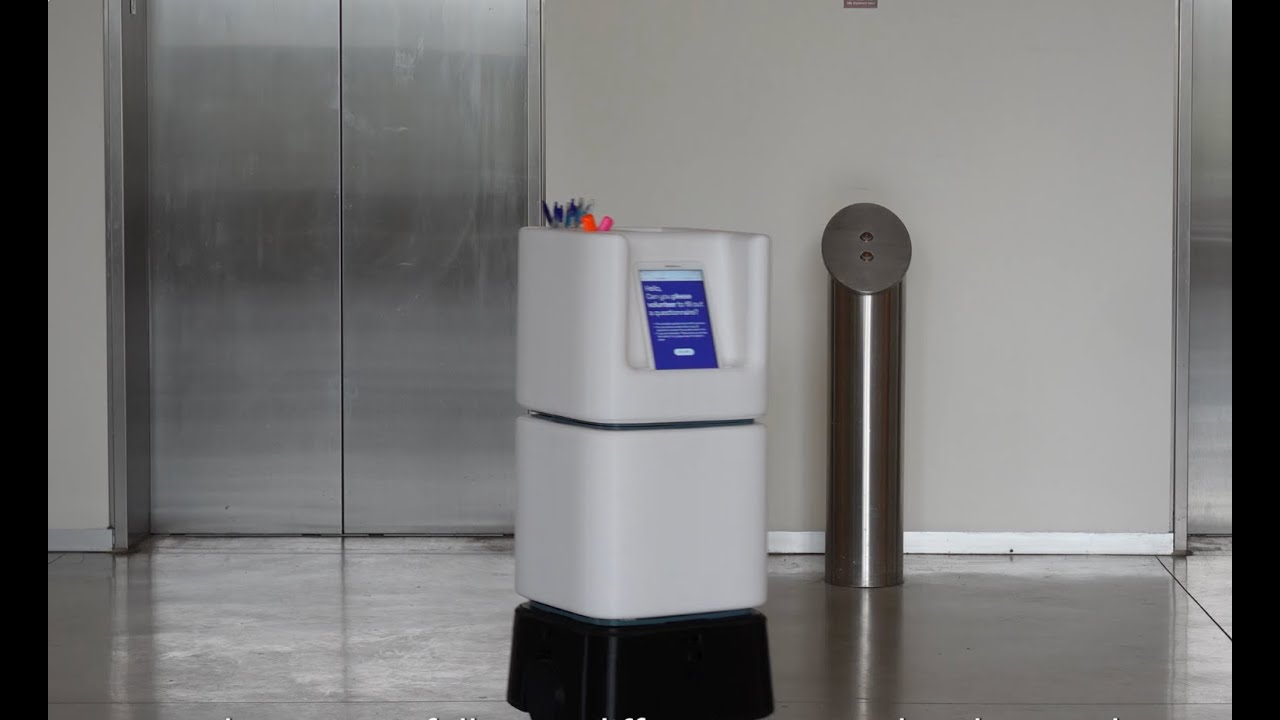
The service table form was intentional: familiar, neutral, and unobtrusive. It blended into the lab environment naturally, reducing the chance that the robot's novelty, rather than its height, would drive participant behaviour. The robot was controlled via a PS4 controller using the Wizard-of-Oz technique, so it felt real without requiring autonomous AI.
Design Process
From cardboard mockup to final modular build
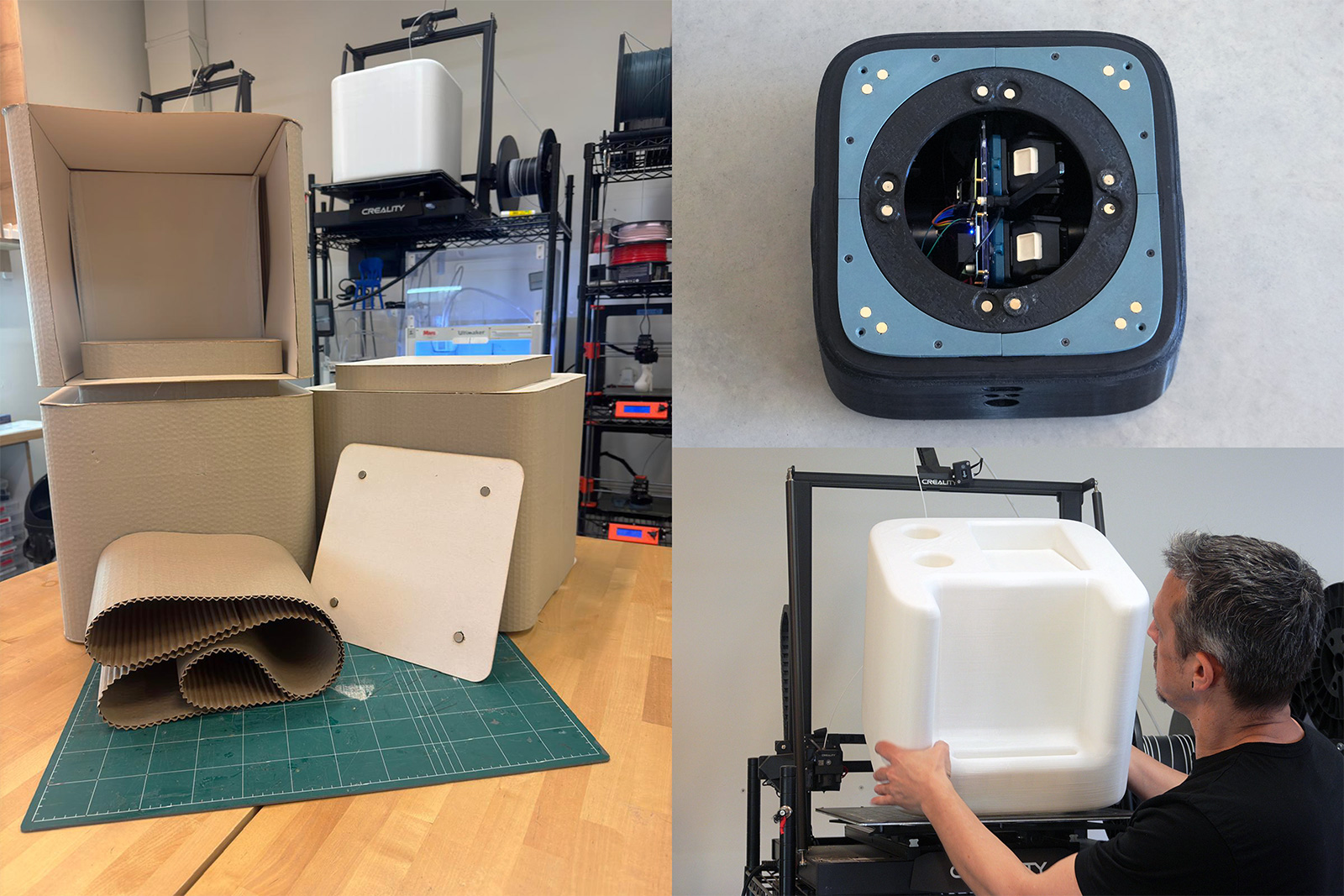
The design went through several iterations before landing on the final form. We started with full-scale cardboard mockups to validate proportions and ergonomics, particularly around how the robot would approach a participant and present the tablet. Even small decisions turned out to matter: early versions placed the tablet inside the top unit, and participants said reaching in felt awkward. Redesigning the tray made the action more inviting.
We then moved through mid-fidelity 3D-printed modules, refining the form, assembly sequence, and the way people physically responded to it. The final version used off-the-shelf components (ESP32, Makita batteries) to allow fast iteration without getting slowed down by hardware complexity.
Color, module configuration, tablet position, and movement were identical across conditions. Any behavioural differences were attributable solely to height.
Experiment Design
A between-participants lab study with 44 participants and two height conditions
44 undergraduate students took part (31 female, 13 male; mean age 23.6), 22 per condition, matched by gender, Agreeableness, and NARS scores. The study used a between-participants design: each participant encountered only one height of the robot, either 95 cm or 132 cm. The encounter took place in a controlled lab room. After completing a Stroop cognitive task (the cover study), the researcher declared the session over and left. MORPHY then entered the room and approached the participant, carrying a tablet loaded with a 300-question questionnaire. Participation was entirely voluntary: participants could ignore the robot, or stop after any 25-question block. Afterwards, they completed the RoSAS and a short interview.
Key Findings
The short robot elicited significantly more compliance than the tall one
Short robot · 95 cm
Tall robot · 132 cm
Despite looking less dominant, the short robot was significantly more persuasive. The social logic from human-human interaction did not carry over.
F(1, 40) = 4.00, p = 0.05Nearly all participants in both conditions picked up the tablet: 17 of 22 in the short robot condition, 15 of 22 in the tall robot condition. This difference was not statistically significant. What differed was how far they went. Participants with the short robot completed significantly more of the questionnaire.
Perception Differences (RoSAS)
Only discomfort separated the two conditions
RoSAS (Robotic Social Attributes Scale) is a validated 9-point questionnaire measuring robot perception across three subscales: warmth, competence, and discomfort.
↓ Discomfort (Short robot)
Short robot M=1.87 vs. Tall robot M=2.74, F(1,40)=3.9, p=0.05. Participants felt significantly more at ease with the shorter robot.
≈ Warmth & Competence
No significant differences on warmth (Short 3.64, Tall 3.73) or competence (Short 5.37, Tall 5.55). Discomfort alone drove the compliance difference.
What Participants Said
Participants didn't mention height explicitly. Their impressions mapped directly onto it nonetheless.
Interviews were transcribed and thematically coded by three researchers, with a fourth resolving inconsistencies (inter-rater reliability Kappa=81%).
"I just wanted to help." · "Why not try? It's a robot with a tablet asking questions."
Theme 1, Prosocial framing: The short robot felt approachable enough to engage with. The interaction felt voluntary, not demanded.
"It brings you things. It's cool." (Short) vs. "It's too tall and wide; I don't see the use." (Tall)
Theme 2, Functional interpretation: Positive functional descriptions were more common in the short robot condition (16/22) than the tall (10/22). The short robot was perceived as purposeful. The tall robot was sometimes seen as too imposing, without an obvious use.
"Cute" · "Helpful" · "Alive" · "Engaging" (Short) vs. "Weird" · "Demanding" · "Scary" · "Nervous" (Tall)
Theme 3, Affective response: Positive general perception was more prevalent in the short robot condition (14/22) than the tall (8/22). These patterns suggest that the valence of how a robot is perceived may shape its persuasiveness, with a positive impression leading to increased compliance.
Design Implications
Height alone shaped the interaction before a word was spoken
No speech. No gaze. Height alone shaped the interaction. That is the point: design is the interaction.
The social logic doesn't carry over
With humans, taller signals authority and compliance follows. With non-humanoid robots, the effect reversed. The mechanism appears to be different.
Positivity drives compliance
For voluntary cooperation, how approachable and positive a robot feels matters more than how dominant or authoritative it looks.
Height is not a neutral decision
It shapes user behaviour before any word is spoken or gesture is made. It is not a neutral design default.
Map morphology empirically
You cannot lift elements from human social dynamics and apply them to robots directly. The effect of a physical feature needs to be tested in the specific robotic context.
Limitations
One robot form, one brief encounter
The robot was designed as a service table, which limits generalization to other morphologies. The interaction was brief and single-encounter, so it is unclear whether the effect persists over time or changes with repeated exposure. Future work should test the height effect across different robot forms, broader height ranges, and longer interactions.
Conference Presentation
IEEE Ro-MAN 2025 · Eindhoven, Netherlands
The study was presented at IEEE Ro-MAN 2025 in Eindhoven, Netherlands.
What Came Next
A follow-up study on sequential robot encounters and anchoring effects
This study raised a new question: what happens when people encounter robots of different heights sequentially? Does the first robot anchor expectations and change how the second is perceived?
That became my follow-up study: "Relative Encounters: Height Anchoring Effects Across Sequential Robot Encounters", accepted for IEEE Ro-MAN 2026.
Faber, M., et al. (2025). A Matter of Height: The Impact of a Robotic Object on Human Compliance. IEEE International Conference on Robot and Human Interactive Communication (Ro-MAN), Eindhoven, Netherlands.
Acknowledgments
This work was supported by the Israeli Innovation Authority as part of the HRI Consortium, and conducted at the Media Innovation Lab (milab), Reichman University.
Co-authored with Andrey Grishko, Julian Waksberg, David Pardo, Tomer Leivy, Yuval Hazan, Emanuel Talmansky, Benny Megidish, and Prof. Hadas Erel.