Establishing Communication Standards for Autonomous Delivery Robots
A six-month research engagement with General Motors R&D. The question: how should autonomous delivery robots communicate with people? Nobody had a settled answer. We built the framework.
Overview
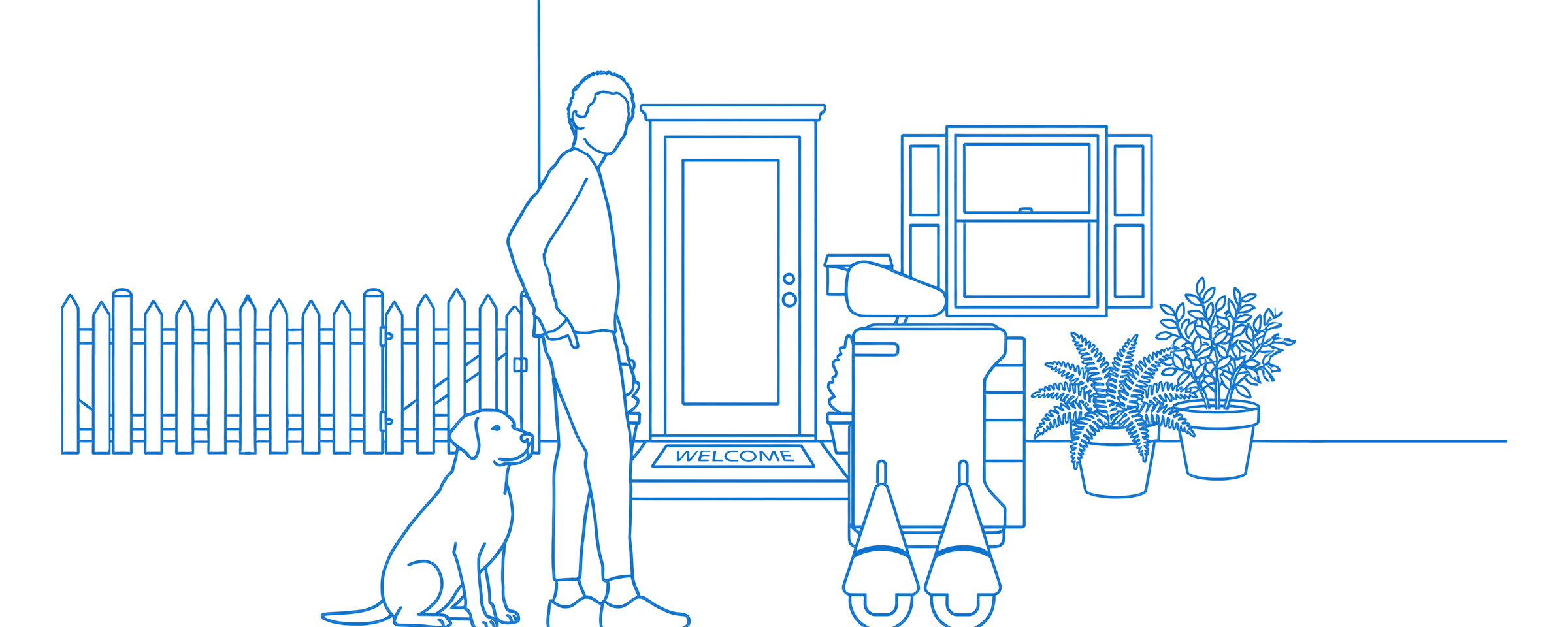
Autonomous objects, particularly in transportation, are increasingly shaping our environments. Car companies are slowly changing their skin, beginning to see themselves as the robotics companies to come, vigorously expanding into autonomous mobile robots (AMRs) and Autonomous Delivery Robots (ADRs) alongside robotics startups and retail giants like Amazon.
While the automotive industry has established standard protocols for autonomous vehicles, no comparable framework exists for ADRs. This project, initiated as part of a collaboration between General Motors R&D and Reichman University's HCI program, steps into that gap.
Problem Statement
We humans communicate through verbal cues, gestures, body language, and eye contact, but how does this translate to interactions with autonomous entities? When encountering an ADR, fundamental questions arise: "Is it approaching me?" "Will it avoid a collision, or should I step aside?" At the core lies the absence of a shared language between humans and delivery robots.
Research
My research adopted a structured and multi-faceted approach. Beginning with established methodologies, I utilized the 8-step eHMI design process and the Double Diamond methodology, tailoring them to the unique challenges in the field of AMRs. The following steps detail the comprehensive strategy employed in the research:
Discover
- Proxemics & Signifiers
- HRI, RRI & HRRI encounters
- Focusing on ADRs
Define
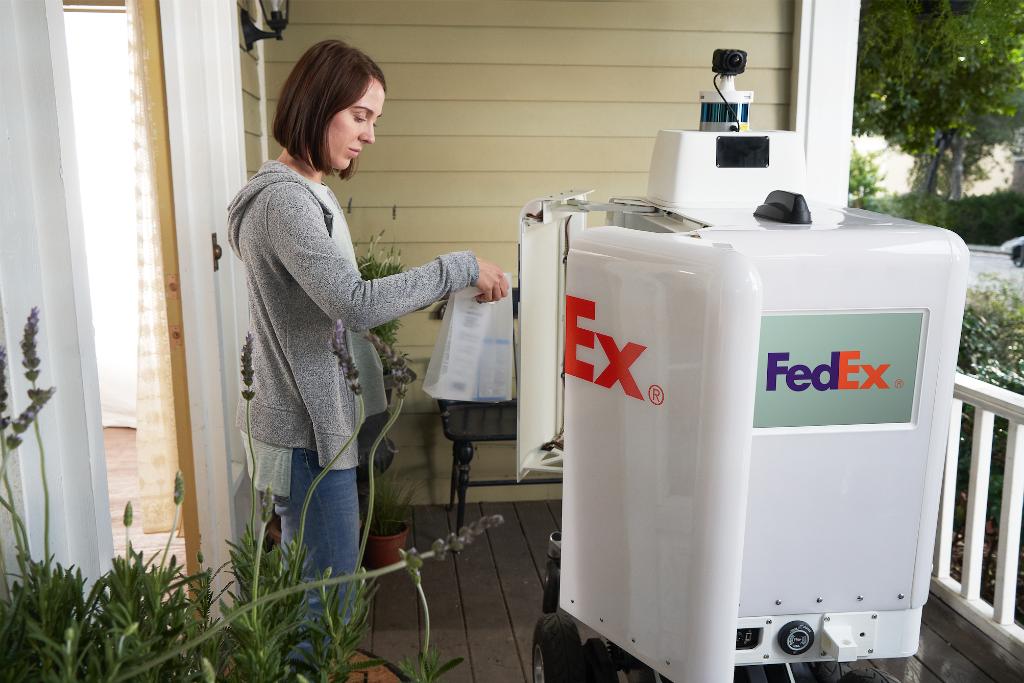
- Industry interview (FedEx)
- Macro user journey
- Benchmark & design audit
Develop
- User interviews
- Micro journey & state machine
- Sequential diagram
Deliver
- ADR modality framework
- Design guidelines
- Future prototype (WOZ, pilot)
Research Limitations
The field is still emerging, and that shaped the research from the start. Academic literature on ADR-specific interaction is thin. Operational robots were largely off-limits for direct observation and testing. Commercial delivery companies, whether out of competitive sensitivity or operational constraints, were reluctant to engage. Furthermore, the study was also geographically constrained, as it was conducted solely in Israel.
What is "Delivery"?
Benchmark, User Journey and Design Audit
Before designing for delivery robots, I needed to understand what delivery actually means as a service. Delivery, which we encounter almost daily, has more to it than first meets the eye. Types, physical constraints, timing, relationships, and expectations vary considerably depending on the service category.
For this research, I focused on last-mile delivery: small to medium packages, same-day or express timelines, typically handled within a radius suitable for motorcycle or car transport. Food delivery, which operates under its own distinct constraints and customer expectations, falls outside this scope.
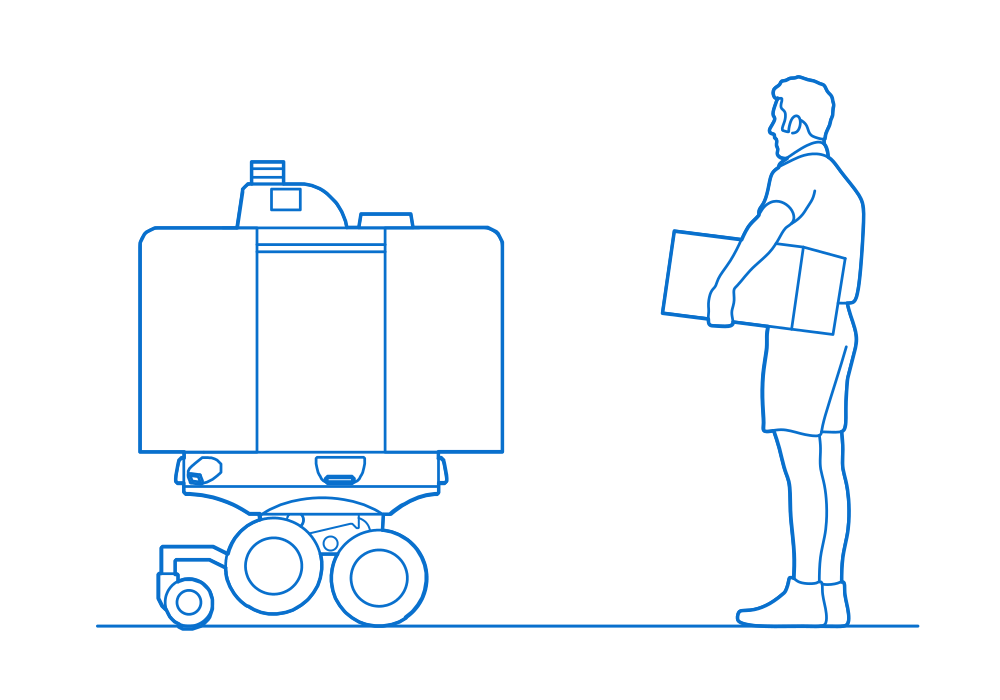
From human couriers to autonomous robots: understanding what changes, and what must not be lost
Market Behavior
Soaring Momentum
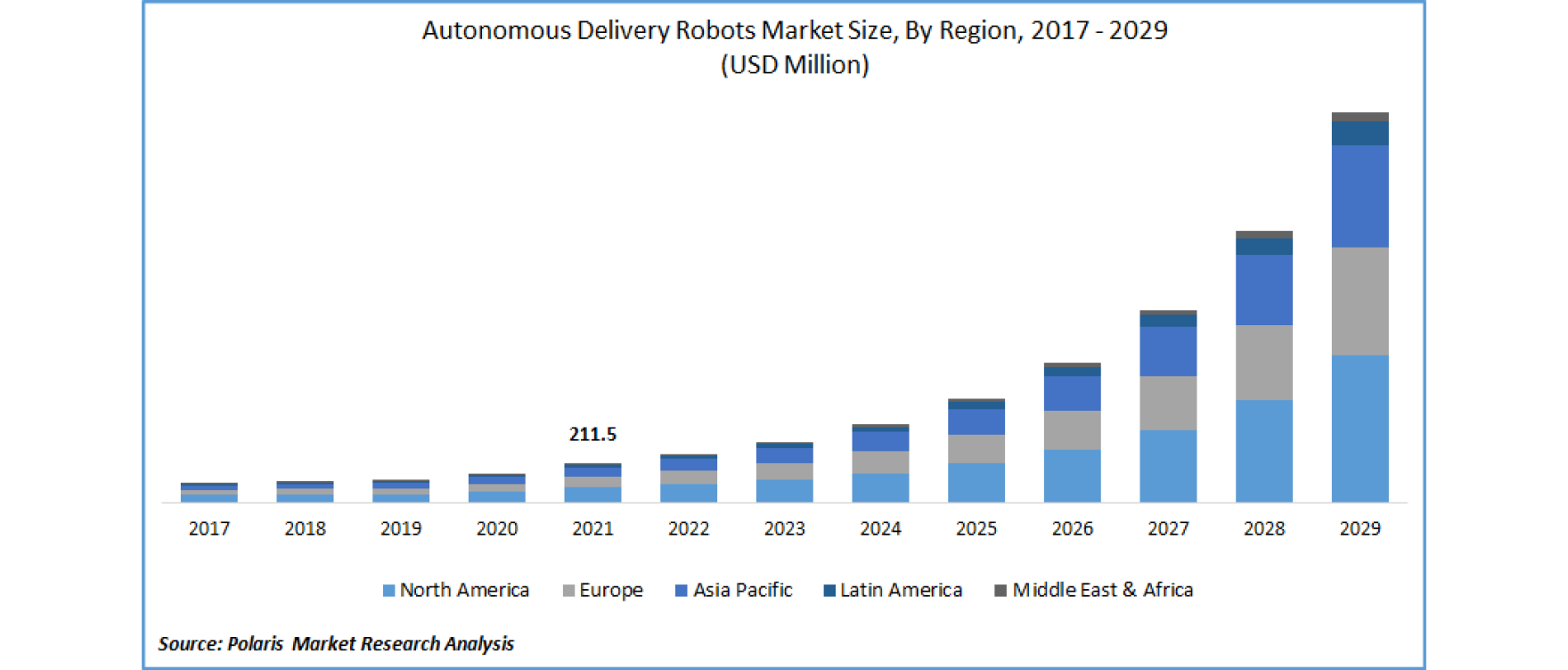
Though ADR acceptance is still debated and regulatory hurdles limit their deployment in public spaces, market analysts forecast delivery robot value reaching around $29B by 2029. Amazon and FedEx have already launched services. That momentum is exactly what makes the absence of a communication standard so pressing.
ADR Landscape
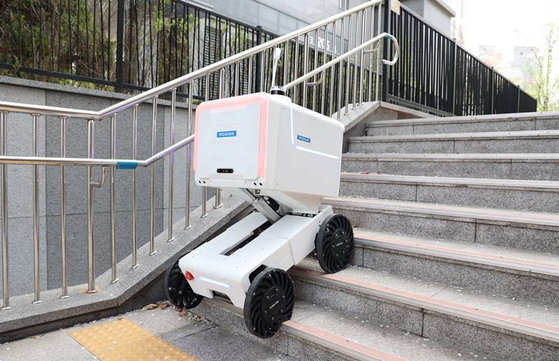
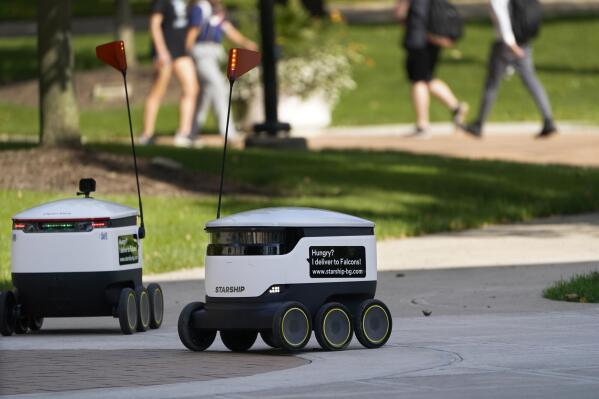
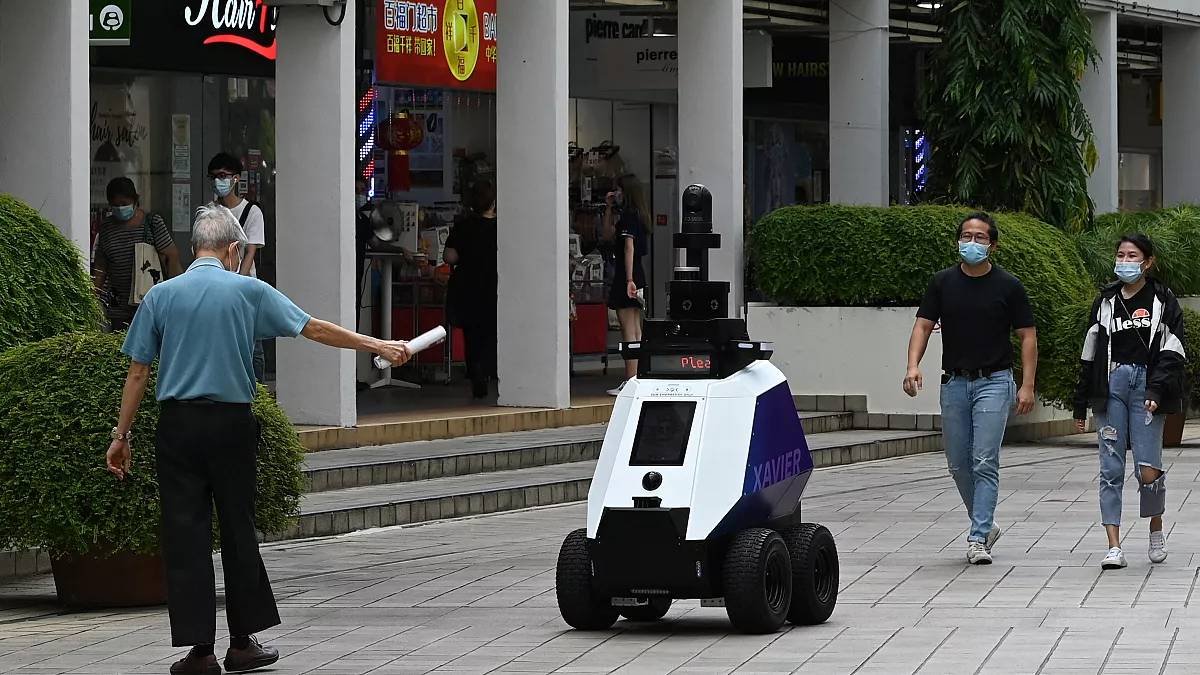
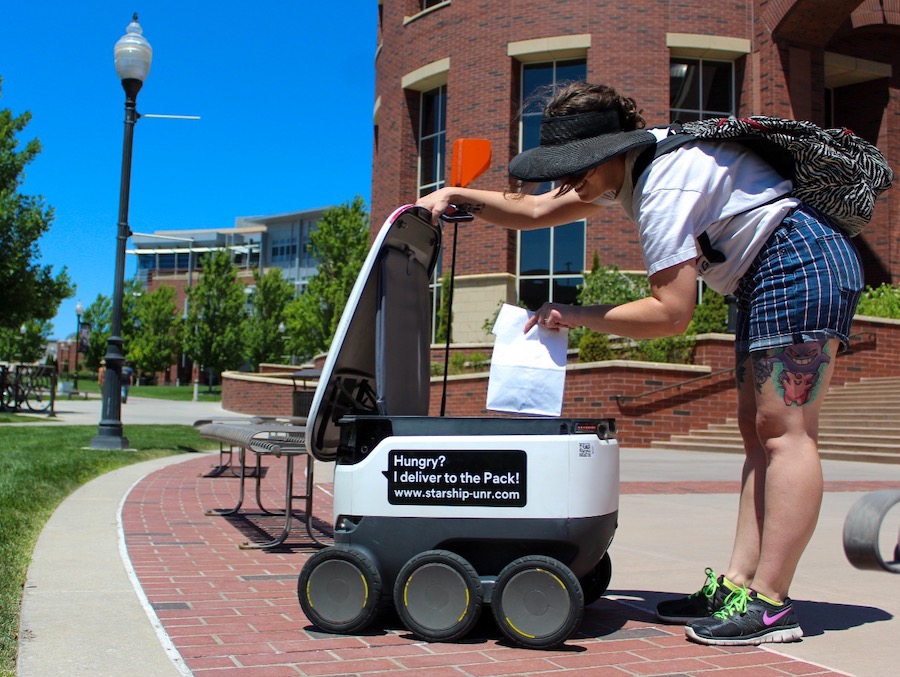
We audited the autonomous delivery robot landscape: Starship, Kiwibot, Nuro, Amazon Scout, Cainiao, and more. Most fall into the same visual language: dome shapes, LED eyes, friendly surfaces. The "cute robot" aesthetic is consistent. The communication frameworks behind them aren't.
No shared vocabulary. No established principles. No clear literature on what makes robot-to-human communication in delivery contexts effective vs. anxiety-inducing. What exists is scattered across automotive HMI, social robotics, and industrial design, none of which maps cleanly onto an ADR context.
Design Audit
Issues to consider
Examining operating ADRs against a set of UX criteria revealed a consistent set of gaps. These aren't edge cases; they appear across brands and form factors:
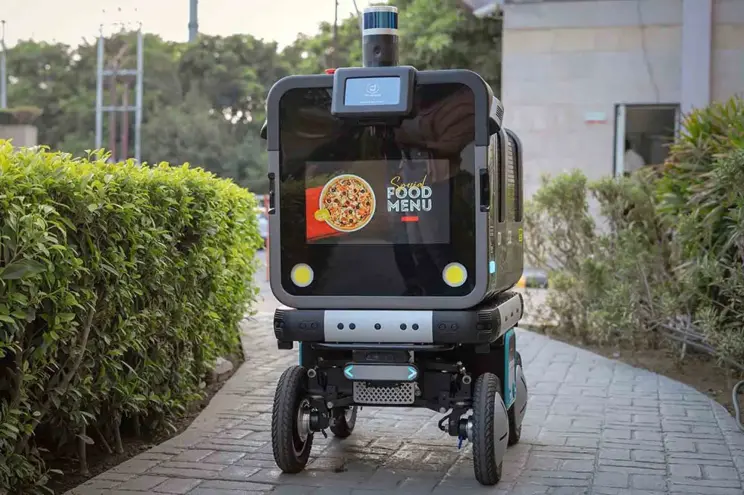
The Spatial Dimension
Spatial behavior and communication cues in HRI
Proxemics
Influence on proxemics behavior in Human-Robot Interaction (HRI)
Edward Hall's proxemics framework describes how humans manage interpersonal space: intimate (0–45cm), personal (45cm–1.2m), social (1.2–3.6m), and public (3.6m+). When a robot crosses those thresholds, something happens, even if people cannot quite articulate it.
In exploring this, I found that comfort zones in HRI are shaped by two layers of factors:
Human Characteristics
Robot Characteristics
Putting it into actionable guidelines: the optimal design sits between 1.2 and 1.5 meters, moves at a deliberate pace, and takes on a non-human form with a defined "head" for directional and communicative gestures.
Signifiers
Establish Communication Baselines
Signifiers can be divided into motion-inherent cues, non-verbal explicit cues, and signaling methods. Compared to the world of autonomous vehicles, signs and cues slightly shift when talking about delivery robots: while a car moves at speed, an ADR usually strolls slower than our walking pace. I will not pretend to present which signal is the most correct, but highlight where and what signals are needed. The exact type of these signals is something we will need to explore further.
Motion-inherent cues
- Speed
- Distance
- Deceleration/Acceleration
- Braking
Non-Verbal explicit cues
- Eye contact
- Head nods
- Gesture
Signaling methods
- Headlights
- Signaling/hazard lights
- Horn
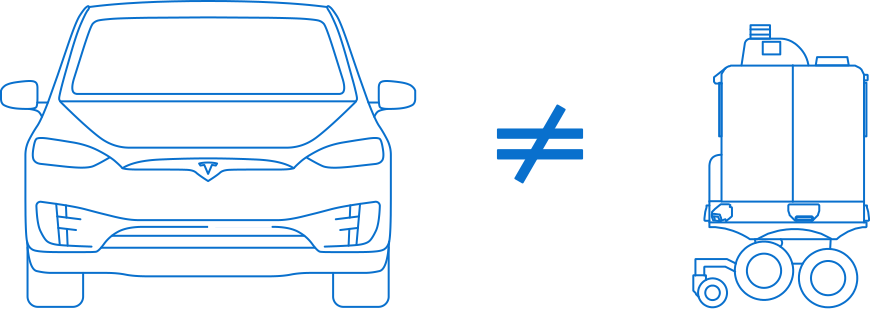
While AVs and ADRs share some basic cues, the signifier language for delivery robots calls for its own framework
User Interviews
What Human Delivery Taught Us
The theory only goes so far. To understand what delivery actually feels like from the receiving end, I spoke with people aged 20 to 65 who regularly receive deliveries, living in both high-rise buildings and private homes, in cities and more suburban areas. The conversations covered expectations and experiences with delivery personnel, trust, behavior at the door, and concerns around privacy and safety.
A somewhat unexpected pattern emerged: the qualities people most valued in a good delivery interaction, coordination, familiarity, a sense of being remembered, are precisely the things a well-designed robot could deliver more consistently than an overloaded human courier.
"What makes for a good experience for me is good communication and coordination of the hand-off time, much before the courier arrives."
"It's gotten to the point where I'm already exchanging a few words with him here and there because he knows me and tells me 'so we meet again...' By now I know him by his name."
"When I got here I had a cultural shock. In Argentina the courier doesn't go up to your apartment, you meet the courier downstairs. That's the norm."
HRI Design Considerations
Personalization
The opportunity to calibrate interaction style to the individual. Proxemics as a dialogue, not a fixed rule.
Cultural sensitivity
Norms around personal space and handoff behavior vary significantly across cultures and geographies.
Familiarity & attachment
Giving the robot a name or consistent personality cue builds trust and reduces friction over repeated encounters.
Service design
The experience starts before the robot arrives. Coordination and communication are part of the interaction, not a prerequisite to it.
Prolonged presence
People want to feel remembered, not processed. Small cues that suggest the robot is "thinking of you" build warmth and increase acceptance.
Delivery Context
From encounter types to the delivery handoff
Looking into how robots move through space, three main encounter types emerge: with the environment (entering buildings, crossing roads), with other robots (navigating swarms on sidewalks), and with people, especially at the delivery handoff. This last type, the human encounter, is where the research focused next.
The Journey
Of Both the Robot and the User
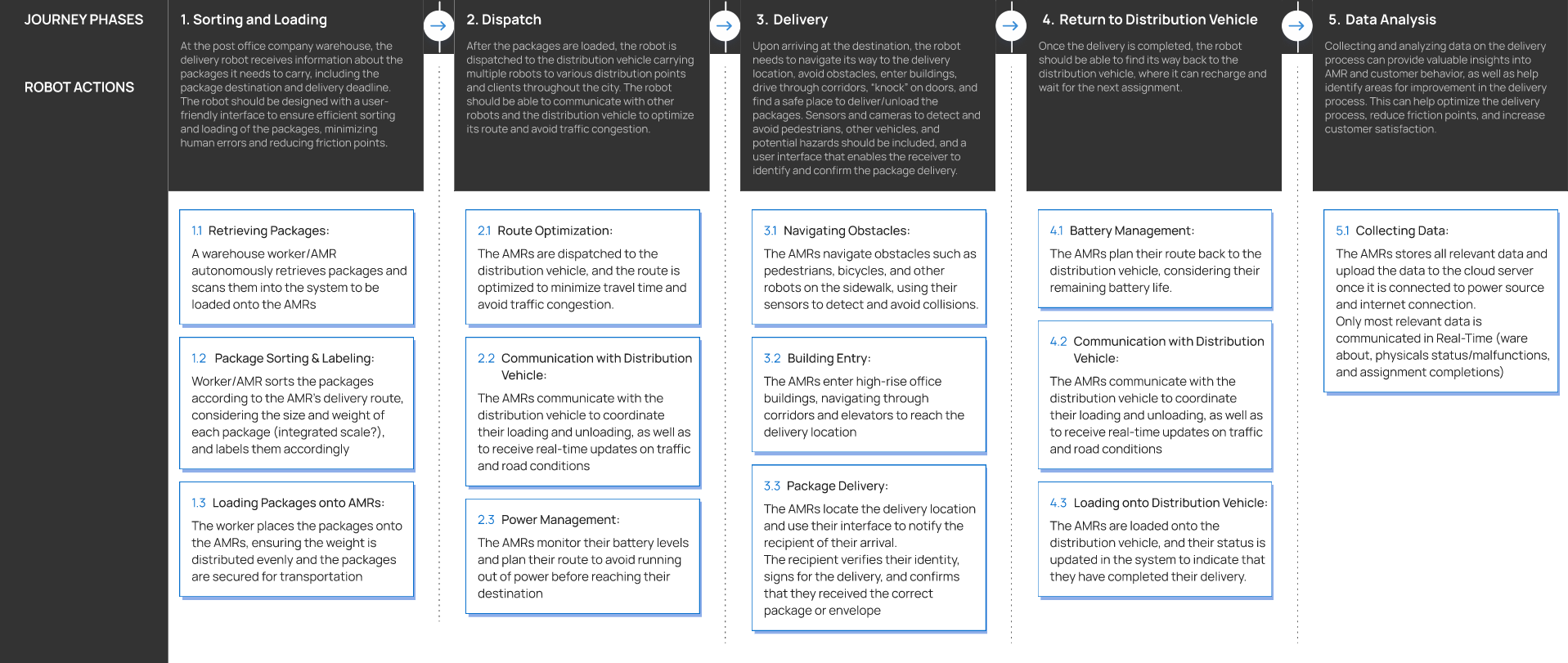
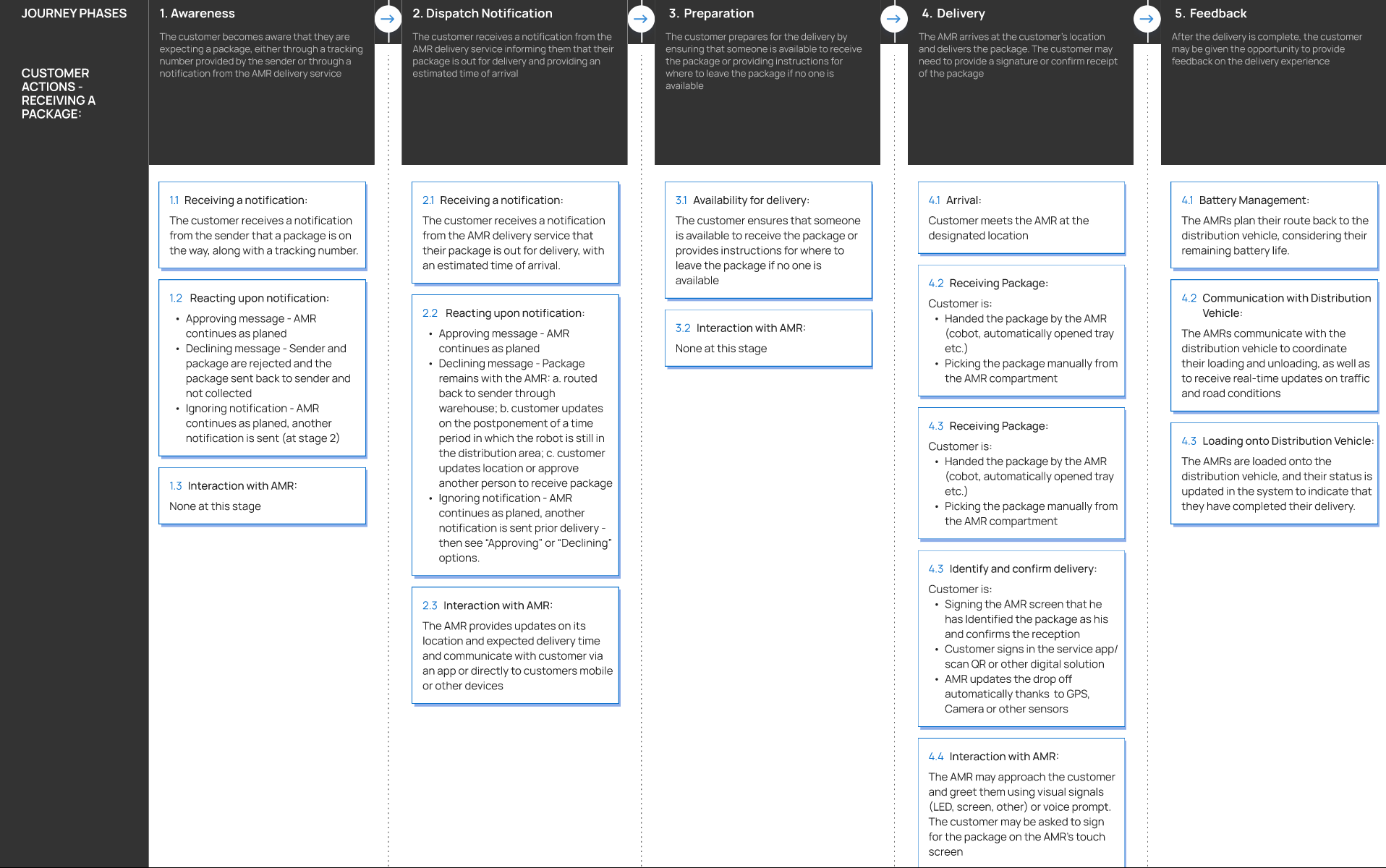
To better understand the process from both sides, I developed a macro mapping of the delivery journey up to the point of human interaction, tracing both the robot's operational path and the customer's experience in parallel.
Focusing on a Specific Encounter
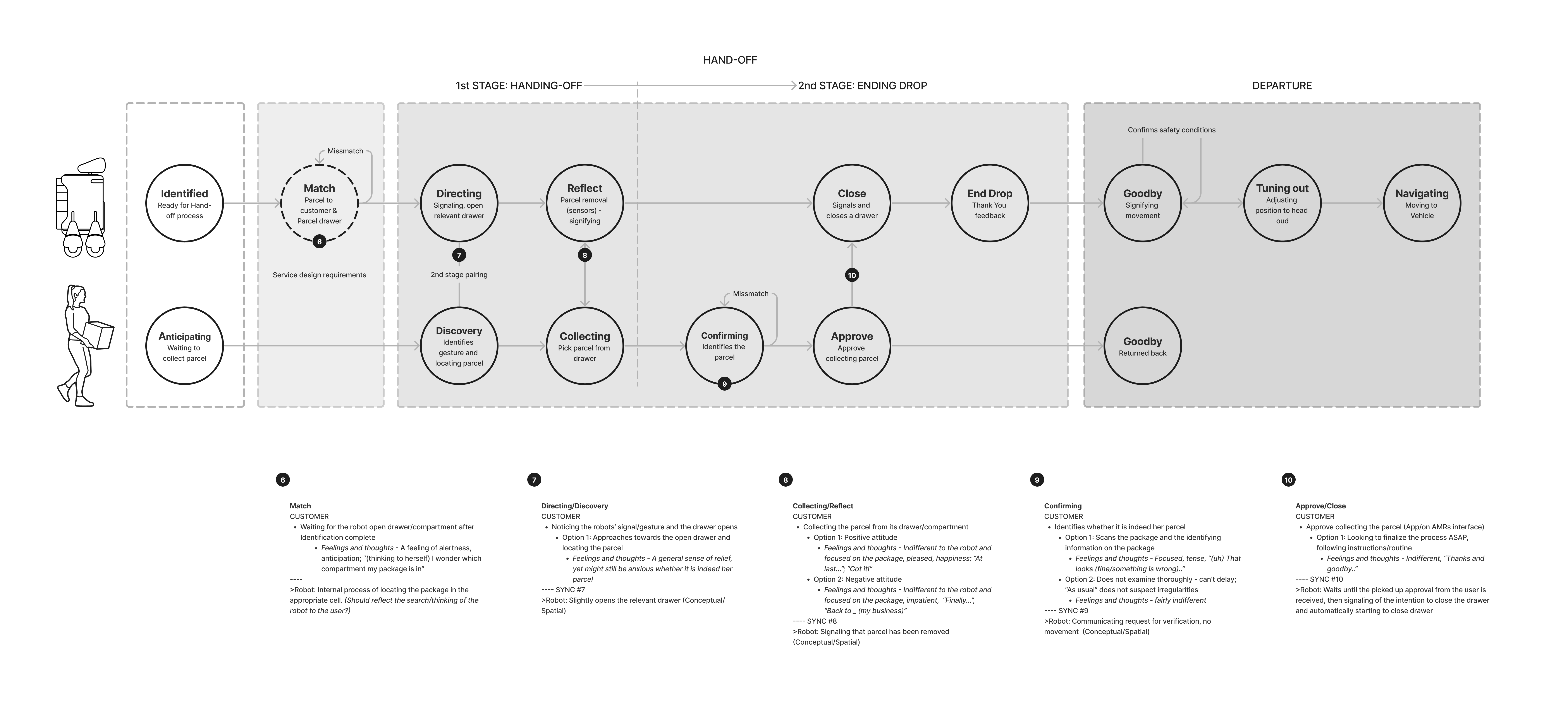
Personal Same-Day Delivery State Machine
At this point, my attention turned to mapping out the "dance," the crucial moment of interaction between the robot and the recipient. Paying attention to the progression of emotions, thoughts, and actions that unfold during this encounter, considering the recipient's varying mindsets throughout the experience.
Design
ADR Communication Framework
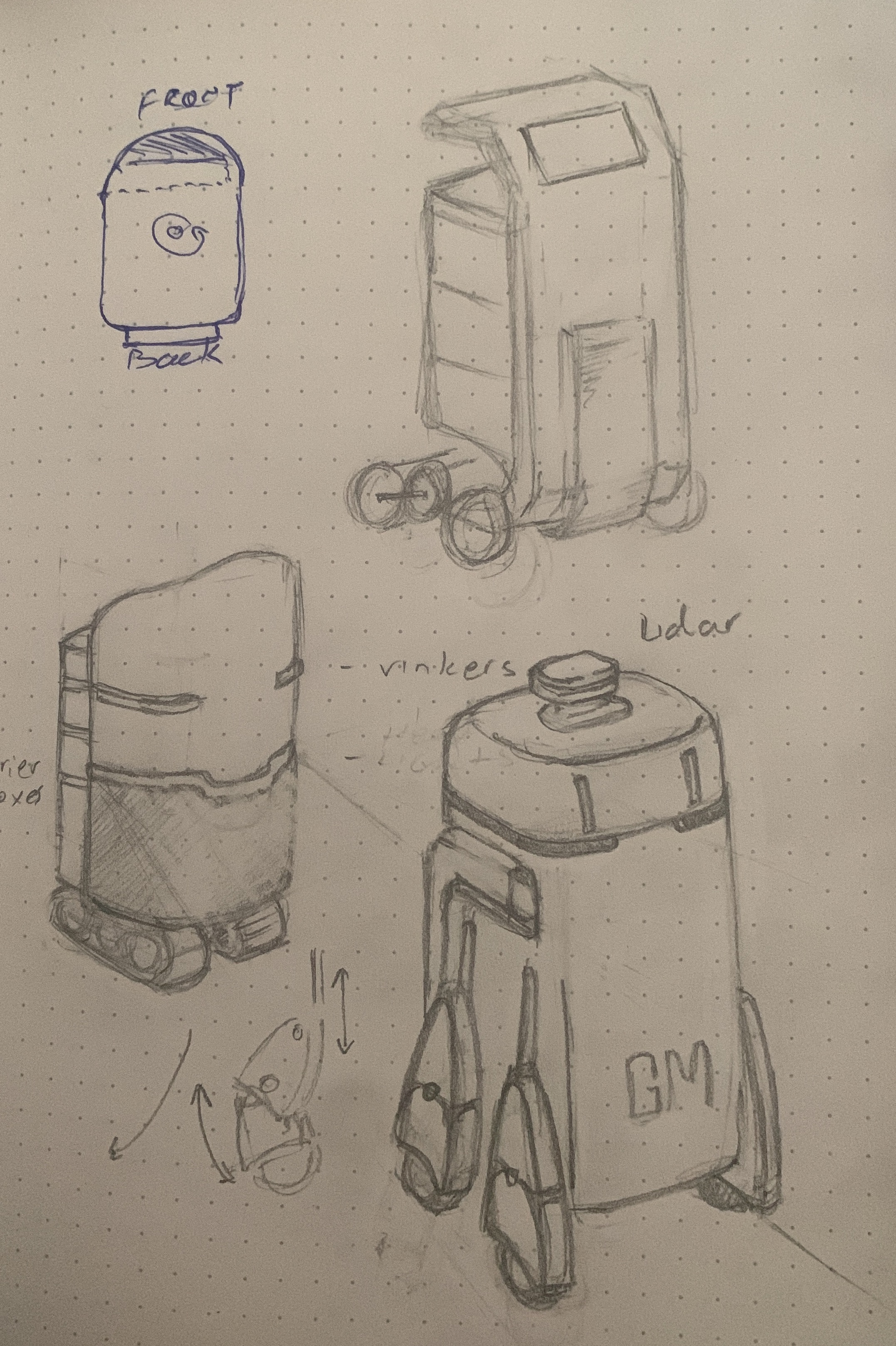
The research consolidated into a set of guidelines for ADR communication design. For form factor: a height between 1.2 and 1.5 meters, a defined "head" for directional cues, and a non-human form. For movement: deliberately slower than human walking pace, with clear deceleration signals. For signaling: a layered system of motion-inherent, non-verbal, and explicit cues calibrated to the three encounter types.
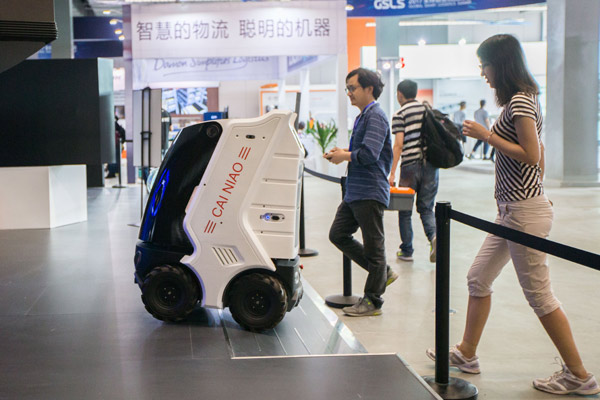
Of existing products, Alibaba's Cainiao robot comes closest to these guidelines, not by coordination with this research, but because similar constraints tend to drive similar solutions.
Communication Protocol
Extending the AV Standard for Delivery
AV eHMI frameworks give us a starting point, not a complete answer. There is no driver, the speed and scale are different, and the nature of the interaction is personal rather than transient. The protocol needs to expand, not just translate.
The result is a proposed set of ADR-specific communication states, extending the existing AV standard with states unique to the delivery context: approaching with recognition, acknowledging the recipient, handing off, and departing.
Autonomous Vehicles
Autonomous Delivery Robots
Filled states are new to the ADR context. Faded states are carried over from the AV eHMI standard.
Takeaways
A Work In Progress
One of the most significant lessons from this project was the value of finding the real challenge beneath the surface. Identifying the core problem mattered not only for developing the right solution, but for something equally important: giving stakeholders a shared frame. When everyone is oriented around the same root issue, communication and decision-making across the project become much clearer.
Working in a forward-looking R&D environment at the intersection of automotive and robotics has been a genuinely exciting space to operate in. This is where early ideas get formed, where research can influence the direction of technology before it's set. That combination of challenge and possibility is exactly where I want to be doing this work.
There is still plenty ahead. The next step is developing a working prototype at Reichman University's Milab lab for initial user testing. That process will help refine the communication models and design guidelines, with the goal of moving toward practical applications within ongoing company projects.