Relative Encounters: Height Anchoring Effects Across Sequential Robot Encounters
Study 1 showed that a shorter robot elicits higher compliance than a taller one. But what happens when people encounter robots of different heights one after another? Does the first robot set a reference point that changes how the second is perceived?
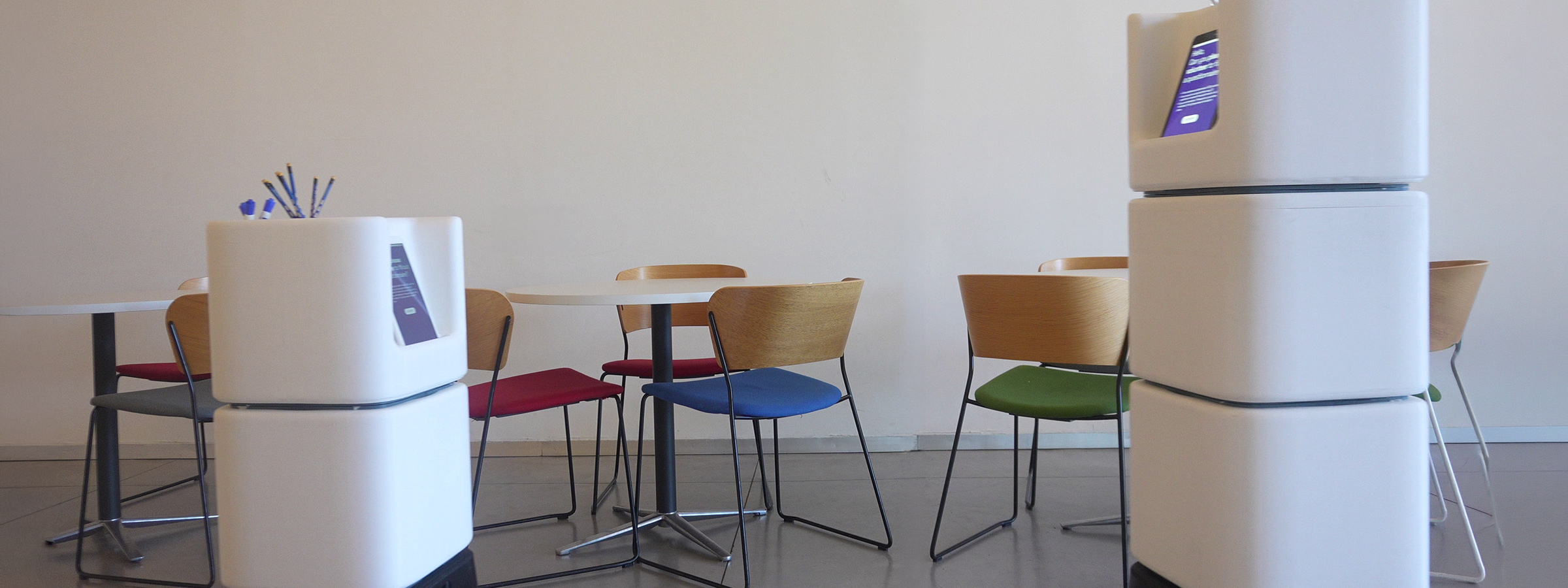
Research Question
Can a prior robot encounter change how you respond to the next one?
Study 1 (A Matter of Height) established that robot height influences compliance in isolated encounters. But real-world robot deployments don't happen in isolation. In logistics hubs, hospitals, and public spaces, people encounter multiple robots, often in sequence.
Anchoring theory from psychology describes a well-documented cognitive bias: judgments are shaped by previously encountered information that serves as a reference point. This applies to numerical estimates, prices, and also to physical attributes like height. The question was whether the same bias operates when people encounter robots sequentially and whether a prior robot encounter changes how the next one is perceived and responded to.
The compliance effect of a robot's height would be intensified when that height differed from the height of a previously encountered robot. The Anchor would set a reference point that amplifies the social impact of the Target robot's height.
Experiment Design
A 2×2 between-participants design with 80 participants across four anchor-target sequences
80 undergraduate students (60 female, 20 male; mean age 23.6, range 18-31) participated, 20 per condition. They were recruited from Communication, Psychology, and Computer Science departments and received course credit or a shopping voucher as compensation. Groups were balanced by participant height, gender, Agreeableness, and NARS scores. Bayesian analysis confirmed no pre-existing differences between groups (NARS: BF₁₀ = 0.21; Agreeableness: BF₁₀ = 0.27; Participant height: BF₁₀ = 0.1).
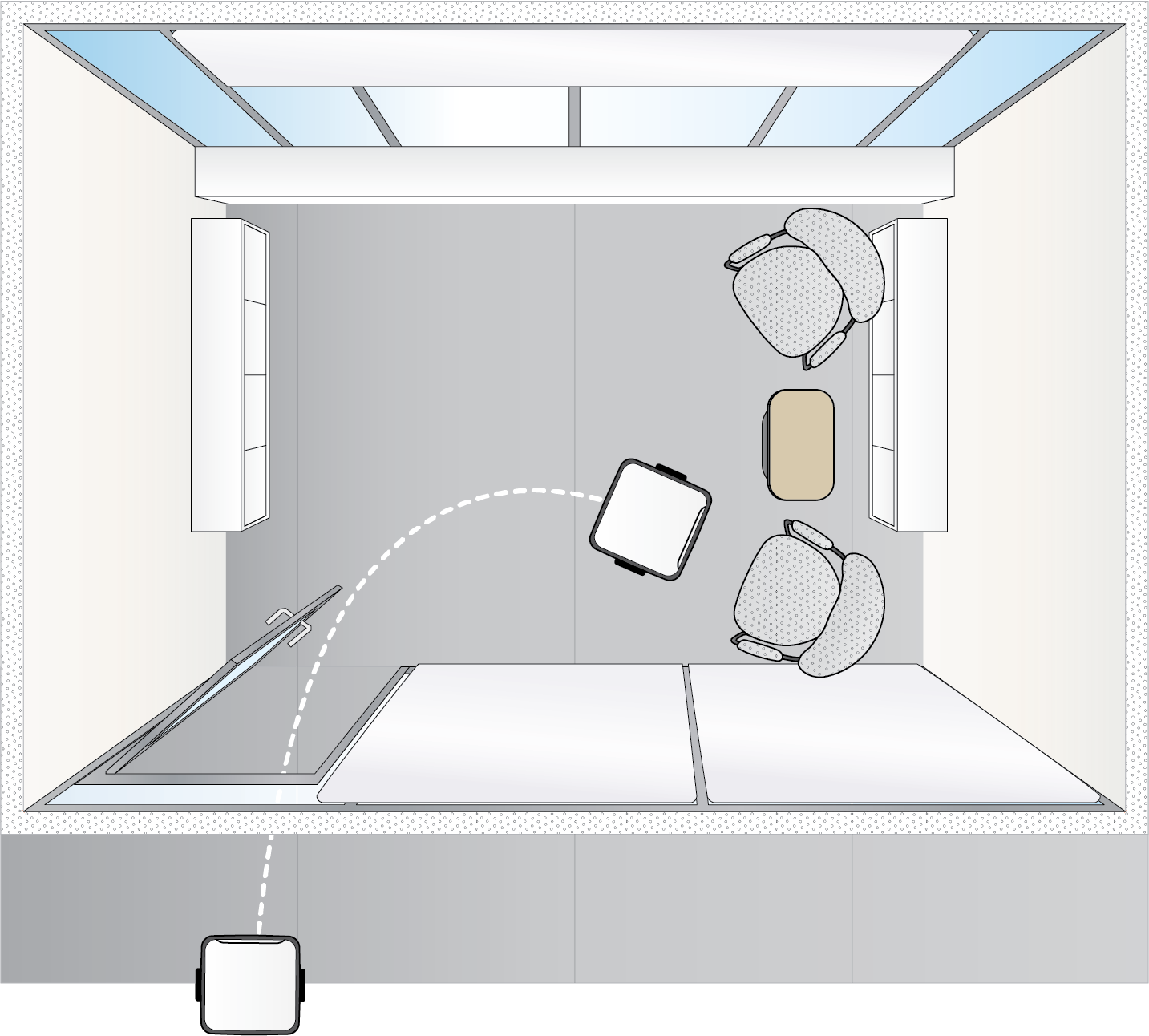
The study used MORPHY, the same modular service-table robot from Study 1, in the same lab room, operated via Wizard-of-Oz (PS4 controller). Participants remained seated throughout the experiment, which controlled for height-related variance and kept the robot's tablet screen in direct visual field across all conditions. Each participant experienced two encounters: an Anchor robot and a Target robot. Height was not directly assessed during the study to preserve ecological validity and avoid priming participants to attend to the manipulation.
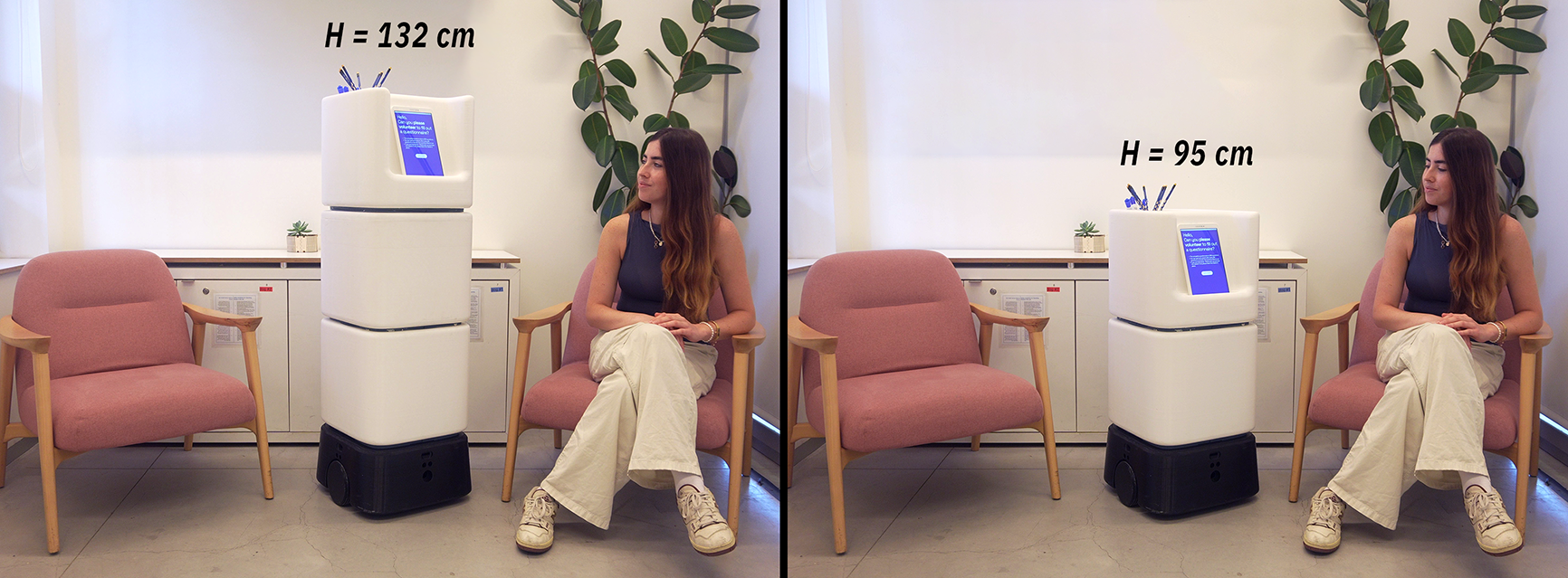
Anchor encounter (mandatory): Before the Stroop task, a robot entered carrying the demographics questionnaire. Participants were told this was a required part of the experimental procedure. The Anchor robot was Short (95 cm) or Tall (132 cm).
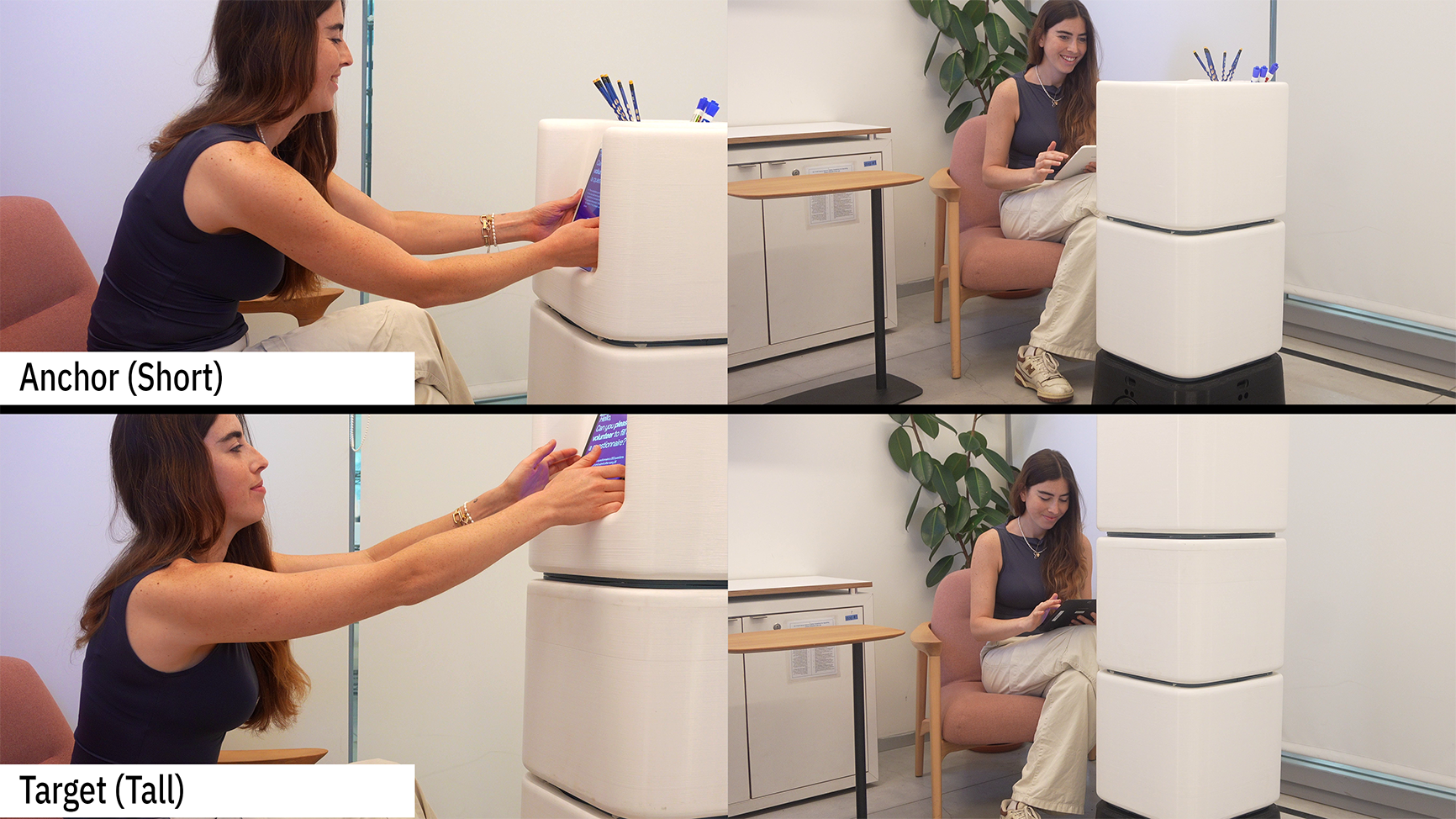
Target encounter (voluntary): After the Stroop task, the researcher declared the experiment complete and left the room. The Target robot then entered carrying a tablet with a voluntary invitation to complete a 300-question questionnaire, the same paradigm used in Study 1. The Target robot's height was either the Same as or Different from the Anchor.
Four conditions: all combinations of Short and Tall across Anchor and Target encounters · Mean questions answered shown per condition
Key Findings
The same robot received significantly different compliance depending on what came before it
The same Short robot received 31% more compliance when preceded by a Tall Anchor than when preceded by another Short robot. The same Tall robot received 40% less compliance when preceded by a Short Anchor than a Tall one. The prior encounter, not the robot itself, drove the gap.
Interaction: F(1, 75) = 4.08, p = 0.05 · Target height main effect: F(1, 75) = 12.73, p < .001Compliance was measured as the number of questions participants answered, with the option to stop after each 25-question block. A two-way ANCOVA (with participant height as a covariate) revealed a significant interaction between Target robot height and its relation to the Anchor. Under the Same condition, the Short Target led to more compliance than the Tall Target (p = 0.05). Under the Different condition, this effect was significantly larger (p < .005). The amplification from Same to Different was itself significant (p < .001).
A: Same-height condition · B: Different-height condition · * p = 0.05, ** p < .005
Perception Differences (RoSAS)
Discomfort tracked the compliance pattern, but only when the heights differed
RoSAS was collected for both the Anchor and Target robots. For the Target robot, the discomfort subscale showed the same interaction pattern as compliance.
↑ Discomfort (Tall Target after Short Anchor)
Discomfort with the Tall Target was significantly higher when preceded by a Short Anchor, but not when preceded by a Tall Anchor. Interaction: F(1,75)=5.54, p=0.02. Post-hoc contrast in the Different condition: p=0.004.
≈ Warmth & Competence
No significant interactions or main effects on warmth or competence. The anchoring effect was specific to discomfort, consistent with Study 1's finding that discomfort mediates the compliance effect of height.
What Participants Said
When heights differed, preferences emerged. When they matched, participants had none.
Interviews were transcribed and thematically coded by three researchers (inter-rater reliability Kappa=81%). Two themes emerged: robot perception and preference between the two robots.
Robot Perception
Short robots described positively; tall robots received a more mixed response
"The short robot felt kind of cute to me. I found myself smiling at it because it was small."
Short robots were frequently described in positive terms across all conditions (Same-Short: 14/20; Different-Short: 13/20): "cute," "approachable," "pleasant." Tall robots also received mostly positive descriptions (Same-Tall: 12/20; Different-Tall: 14/20), often pointing to presence or capability: "It seems useful. It drove, navigated, and even went through the door without getting stuck." A portion were neutral (6/20 in each condition), and a small number were negative: "It towers over you; it's stressful and intimidating."
Preference Between Robots
Contrast created the preference; without it, there was none
"I don't really have a specific preference." (Same-Short, 20/20 participants)
In Same-height conditions, preferences were near-universal: participants in both Same-Short (20/20) and Same-Tall (20/20) reported no preference between the two robots they encountered.
"After the small one, this one [tall robot] felt kind of intimidating."
In Different-height conditions, clear preferences emerged. In Different-Short (Tall Anchor then Short Target): 9/20 preferred the Short Target, 6/20 preferred the Tall Anchor, 5/20 had no preference. In Different-Tall (Short Anchor then Tall Target): 11/20 preferred the Short Anchor, 4/20 preferred the Tall Target, and 6/20 had no preference. Those who preferred the short robot described it as more pleasant and approachable; comments toward the Tall Target more often highlighted negative rather than positive qualities. Preferences only emerged when there was a contrast to anchor against.
Design Implications
Sequence matters as much as form
If Study 1 established that robot height matters, Study 2 establishes that deployment sequence matters too. The same robot, with the same height, will be experienced very differently depending on what came before it.
Design for sequences, not single encounters
In multi-robot environments, the order in which robots are encountered is part of the design. A robot's effectiveness is shaped by the context it enters, not just its own attributes.
Use contrast strategically
A short, approachable robot deployed after a taller one may receive significantly more compliance than it would in isolation. The sequence can work for you.
Beware of backfire effects
Deploying a tall robot after a short one may suppress compliance below what the tall robot would achieve on its own. Context can work against you.
Height is relational, not absolute
The compliance effect of a robot's height cannot be predicted in isolation. It is shaped, in part, by what users have previously experienced.
Together, Studies 1 and 2 show that design features in HRI operate within a relational layer: a robot's influence depends not just on its own attributes but on what the user has previously encountered. In a warehouse or service environment, the question is no longer only "what height should this robot be?" It becomes: "what will the user have just experienced before they meet this robot?"
Limitations
Single robot form, no baseline control, and an unexplored set of mediating factors
The robot's service table form limits generalization to other morphologies. The study did not include a No-Anchor control condition, which would further isolate the relative height effect. Mediating factors, including questionnaire length, cultural perceptions of height, and tablet screen position, remain unexplored. Effects in longer or more naturalistic interactions, or with different request types requiring varying effort levels, may differ from those found here. The qualitative findings may also have been influenced by the Good Subject Effect; a strict protocol was followed and participants were told all responses were valuable.
Conference Presentation
IEEE Ro-MAN 2026
This video was submitted as part of the conference presentation for IEEE Ro-MAN 2026.
What Came Next
Open questions in relational morphology
This study opens several directions. Future work should test anchoring effects across different robotic morphologies and interaction styles, examine standing and moving interactions, and explore broader height ranges and robot-participant height relations. A No-Anchor baseline condition would help further isolate the relative height effect. Whether anchoring generalizes to other robot attributes beyond height is a question worth pursuing.
← Read Study 1: A Matter of Height
Faber, M., & Erel, H. (2026). Relative Encounters: Height Anchoring Effects Across Sequential Robot Encounters. IEEE International Conference on Robot and Human Interactive Communication (Ro-MAN), 2026. Accepted.
Acknowledgments
Conducted at the Media Innovation Lab (milab), Reichman University.
Co-authored with Prof. Hadas Erel.